Need it handled? Call (706) 247-2197
Car Detailing: Home – McPherson Mobile Detailing can help. Call (706) 247-2197 for a free estimate.
TL;DR: Monroe's moderately hard water leaves stubborn mineral deposits on car paint that require different removal methods depending on severity. Type 1 spots (surface mineral scale) come off with a $13 DIY vinegar solution; Type 2 spots (etched into clear coat) need clay bar treatment or professional polishing; Type 3 spots (paint damage) require professional correction. The safe removal window in Monroe's summer heat is hours, not days – acting quickly prevents permanent etching.
Why Does Monroe Water Leave Spots on Your Car?
Here in Monroe, we're dealing with a specific water chemistry problem that generic detailing guides don't address. (Epa.gov) (Monroega.gov) Learn more about best mobile car detailing in Monroe. The City of Monroe draws its water supply from Hard Labor Creek Reservoir, which contains moderate levels of calcium and magnesium minerals – the exact compounds that bond to your car's clear coat when water evaporates.
When you wash your car or it gets rained on, that mineral-laden water sits on the paint. As the water evaporates in our Georgia heat, it leaves behind calcium carbonate and magnesium deposits. These aren't just surface dirt – they're chemically bonded to the clear coat. The harder the water, the faster and more stubborn the spots form. Monroe's water hardness falls in the moderate range (roughly 100–150 mg/L as calcium carbonate equivalent), which is enough to create visible spots within hours during summer.
The real urgency comes from our climate. With annual rainfall around 50 inches and summer UV index reaching 7–10, water droplets act like tiny magnifying glasses on dark paint. The sun's heat accelerates the bonding process, turning a removable Type 1 spot into an etched Type 2 spot in a matter of hours during peak summer conditions. That's why Monroe car owners can't afford to wait – the longer spots sit, the deeper they etch.
Key Takeaway: Monroe's moderate water hardness combined with high summer UV creates a narrow treatment window. Spots that sit for more than a few hours in direct sun can progress from surface deposits to permanent clear coat etching.
How Do You Know What Type of Water Spot You Have?
Before you grab supplies, you need to diagnose what you're dealing with. Not all water spots are created equal, and using the wrong removal method can make things worse. Here's how professional detailers classify them – and how you can identify which type is on your car.
Type 1: Surface Mineral Deposits
These are the easiest to remove. Learn more about Car Detailing in Monroe. Run your fingernail lightly across the spot – if you can't feel any texture or roughness, it's Type 1. The spot looks like a faint haze or ring. It wipes away partially with a damp cloth but returns after the water dries. Type 1 spots are purely mineral scale sitting on top of the clear coat, not bonded into it. These respond well to dilute acid (vinegar) or detailing spray.
Type 2: Etched or Bonded Spots
Now run your fingernail across again. If you feel a slight roughness or catch – like the spot has a tiny texture – you're looking at Type 2. These spots have begun bonding into the clear coat itself. They don't wipe away with water alone. Type 2 spots require mechanical removal (clay bar) or light polishing. They're more stubborn than Type 1 but still salvageable with the right approach.
Type 3: Paint Etching
This is permanent damage. The spot feels noticeably rough, and you might see discoloration that doesn't match the surrounding paint. Type 3 spots have eaten through the clear coat into the paint layer itself. These require professional paint correction – sanding, compounding, and repainting in severe cases. This is where DIY stops and professional work begins.
The Quick Test:
- Wipe the spot with a damp microfiber cloth.
- If it disappears and stays gone after drying: Type 1 (DIY vinegar method works).
- If it reappears or feels rough: Type 2 (clay bar or professional polish needed).
- If it's rough, discolored, and won't budge: Type 3 (call a professional).
⚠️ Critical Rule: If you can feel the spot with your fingernail, skip DIY machine polishing – go straight to a professional. Inexperienced use of a rotary polisher on etched clear coat can burn through the protective layer in one pass, converting a $50 spot treatment into a $300+ repaint.
Step-by-Step: Remove Light Water Spots at Home
If you've identified Type 1 spots, you can handle this yourself. The entire process takes 30–60 minutes for a full car, and your total material cost comes to under $25. Here's the proven method we see work consistently on Monroe vehicles.
White Vinegar + Distilled Water Method
What You'll Need:
- Distilled white vinegar ($2)
- Distilled water ($1)
- Microfiber cloths, pack of 5 ($10–$12)
- Spray bottle ($3–$5)
- Total cost: $16–$20
Step 1: Test on an inconspicuous area first. Spray the vinegar solution on a small section of your car's undercarriage or inside the fuel door. Wait 2 minutes, rinse with distilled water, and dry. This confirms the solution won't damage your specific paint type.
Step 2: Mix your solution. Combine equal parts distilled white vinegar and distilled water in a spray bottle. A 50/50 ratio creates a mild acetic acid solution strong enough to dissolve mineral deposits without attacking the clear coat.
Step 3: Spray affected areas. Apply the solution generously to water-spotted panels. Don't be shy – you want the spots fully saturated.
Step 4: Let it dwell for 1–2 minutes. This is critical. The acid needs time to break down the mineral bond, but extended dwell time risks damaging the clear coat. Set a timer. Don't exceed 2 minutes.
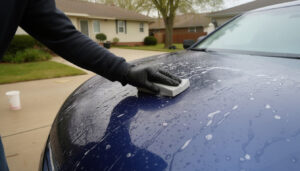
Step 5: Wipe gently with a microfiber cloth. Use light circular motions. The spots should begin lifting. If they resist, apply more solution and wait another minute, but don't scrub hard.
Step 6: Rinse thoroughly with distilled water. This is non-negotiable. If you rinse with tap water, you'll immediately redeposit minerals onto the clean surface. Use only distilled water for the final rinse.
Step 7: Dry with a waffle-weave microfiber towel. Standard terry cloth leaves streaks. Waffle-weave towels absorb water more effectively and prevent new spot formation as you dry.
Time estimate: 30–45 minutes for a sedan; 45–60 minutes for an SUV or truck.
Clay Bar Method for Stubborn Type 1–2 Spots
If vinegar doesn't fully clear the spots, or if you're dealing with Type 2 etching, a clay bar kit is your next step. This method mechanically removes bonded contamination.
What You'll Need:
- Clay bar detailing kit ($15–$20, available at AutoZone or O'Reilly Auto Parts on Hwy 78 in Monroe)
- Clay bar lubricant (included in most kits)
- Microfiber towels
- Additional cost: $15–$20 For more details, see Car Detailing in Downtown Monroe, GA – Professional Auto Detailing Services.
The Process: Knead the clay bar until it's pliable. Spray the lubrication fluid on a 2×2 foot section of paint. Gently glide the clay bar across the surface using light pressure – don't press hard. The clay will feel resistance as it shears bonded contaminants. Fold the clay frequently to expose a clean surface. After clay-barring, the paint feels smooth but porous. You must immediately apply a wax or paint sealant to reseal the clear coat. Skip this step and you're leaving the paint vulnerable to UV and water damage.
Time estimate: 45 minutes for a full car, plus 15 minutes for wax application.
Prefer a local recommendation to start with? Home – McPherson Mobile Detailing is a solid one for Monroe — straightforward about pricing and timing, and quick to respond when you reach out.
✓ Recommended locally: Home – McPherson Mobile Detailing
Serving Monroe. Call (706) 247-2197 or get in touch »
What If the Spots Don't Come Off? (Type 2 and Type 3 Solutions)
You've tried vinegar. Learn more about same-day car detailing in Monroe. Learn more about car detailing costs in Monroe. You've tried clay bar. The spots are still there. This is the moment many Monroe car owners reach – and it's the moment to know when professional help is the right call.
Type 2 spots that survive DIY treatment have etched deeper than surface level. Type 3 spots are permanent paint damage. Both require paint correction: a process that uses compound polish or machine polishing to level the clear coat and remove the etched area.
Why DIY Machine Polishing Is Risky
A compound polish ($20–$40) can work on light Type 2 spots if you apply it by hand. But machine polishing – using a rotary or orbital polisher – demands precision. Without experience, you can generate enough heat to burn through the clear coat in a single pass, especially on dark-colored vehicles like black or dark grey cars. That $50 spot treatment becomes a $300–$600 paint correction or repaint.
Cost Comparison: DIY vs. Professional
| Approach | Cost | Time | Risk | Best For |
|---|---|---|---|---|
| Vinegar + cloth | $13–$20 | 30–45 min | None | Type 1 spots |
| Clay bar kit | $15–$20 | 45 min | Low | Type 1–2 spots |
| Hand compound polish | $20–$40 | 60–90 min | Medium | Light Type 2 spots |
| Professional spot correction | $50–$100 | 1–2 hours | None | Type 2 spots, dark cars |
| Professional paint correction | $150–$400+ | 4–8 hours | None | Type 3, severe etching |
When to Call a Professional:
If your car is dark-colored (black, dark grey, dark blue), skip the machine polisher entirely. Dark paint shows swirl marks and heat damage instantly. Professional detailers have the experience and equipment to correct Type 2 and Type 3 spots without risk.
If your vehicle is leased, any paint correction error can trigger excess wear charges at lease return. Professional treatment protects your security deposit.
If the spots cover more than 20% of the vehicle's visible surface, you're looking at widespread etching. This is a job for professionals with paint thickness gauges and multi-stage correction protocols.
Here in Monroe, professional mobile detailing services like McPherson Mobile Detailing can come to your home, office, or apartment to handle spot correction without you driving to a shop. Same-day availability means you don't have to wait weeks for an appointment.
How Can You Prevent Water Spots From Coming Back?
Removing water spots is one thing. Preventing them from returning is another. Here's what actually works in Monroe's climate.
Immediate Prevention (Free to $5)
Park away from sprinklers and lawn irrigation systems. That automated sprinkler system on your neighbor's lawn? It's running on the same hard water as your tap. Avoid washing your car in direct sunlight – the water evaporates too fast, concentrating minerals on the paint. Dry your car immediately after rain or washing using a waffle-weave microfiber towel. The longer water sits, the more minerals bond to the clear coat.
Mid-Range Prevention ($50–$80 DIY)
Use distilled or filtered water for your final rinse when washing at home. A simple water filter attachment on your hose ($30–$50) removes most minerals before the water touches your paint. DIY ceramic coating kits (like Turtle Wax Hybrid Solutions Ceramic, $50–$80) provide 6–12 months of hydrophobic protection. Water beads up and rolls off instead of pooling and evaporating, dramatically reducing spot formation.
Long-Term Prevention ($300–$600 Professional)
Professional ceramic coating applied by a detailer lasts 2–3 years and costs $300–$600. That amortizes to roughly $12–$17 per month. Compare that to repairing etched water spots at $50–$300 per occurrence, and ceramic coating becomes the financially smarter choice. The hydrophobic layer causes water to bead at contact angles above 100°, meaning water rolls off before minerals concentrate through evaporation.
Prevention Cost Breakdown:
- Waffle-weave towel: $12–$20 (one-time)
- Distilled water for rinse: $1 per gallon
- DIY ceramic coating: $50–$80 (lasts 6–12 months)
- Professional ceramic coating: $300–$600 (lasts 2–3 years = $12–$17/month)
Even if you invest in professional ceramic coating, you'll still need to maintain it with a ceramic maintenance spray (not clay bar or acid treatments, which strip the coating). The long-term payoff is a car that sheds water like a duck and stays spot-free through Monroe's rainy summers.
When Should You Call a Monroe Detailer Instead of DIY?
You've read this far, and you're wondering: is this a DIY situation or a professional one? Here are three clear scenarios where calling a detailer is the right move.
Scenario 1: Dark-Colored Vehicle with Type 2 Spots
Black, dark grey, and dark blue cars show water spots more visibly and have less tolerance for DIY machine polishing errors. If your dark car has etched spots that survived vinegar and clay bar treatment, a professional detailer has the experience and equipment to correct them without risk. The cost ($50–$100 for spot correction) is worth the peace of mind.
Scenario 2: Leased Vehicle
Lease agreements include paint condition clauses. Any DIY polishing mistake that thins the clear coat below specification can trigger excess wear charges at lease return. Professional correction protects your security deposit and keeps your lease-end inspection clean.
Scenario 3: Widespread Etching (20%+ of Vehicle Surface)
If water spots cover a large portion of your car's visible surface, you're dealing with systemic etching that requires multi-stage paint correction. This is beyond DIY scope. Professional detailers use paint thickness gauges, multi-stage compound systems, and finishing polishes to restore the clear coat properly.
The Mobile Detailing Advantage in Monroe For more details, see mobile detailing service near Monroe.
You don't have to drive your car to a shop. Mobile detailing services come to your home, office, or apartment – even to covered garages or open parking lots. McPherson Mobile Detailing operates throughout Monroe and surrounding areas, offering same-day availability for spot correction and ceramic coating application. You can get professional-grade water spot removal without leaving your driveway.
Recommended Car Detailing in Monroe: Home – McPherson Mobile Detailing
When you're ready to move from research to a real quote, Home – McPherson Mobile Detailing is a local team serving Monroe worth calling — a clear estimate and an honest timeline before anything begins.
Frequently Asked Questions About Water Spot Removal in Monroe
How much does professional water spot removal cost in Monroe, GA? For more details, see Car Detailing in Monroe, GA – Professional Auto Detailing Services.
Direct Answer: Professional spot correction for Type 2 etched spots runs $50–$100 in Monroe; full paint correction for Type 3 damage starts at $150 and can reach $400+ depending on severity.
The cost depends on how many spots need treatment and how deep the etching goes. A single-panel spot correction takes 1–2 hours and falls in the $50–$100 range. If etching covers multiple panels or requires multi-stage paint correction, expect $150–$400+. Mobile detailers in Monroe often charge the same rate as shop-based services but eliminate your drive time.
What is the difference between water spots and paint etching on a car?
Direct Answer: Water spots are mineral deposits on the clear coat surface; paint etching is permanent damage where minerals have bonded into or through the clear coat.
Type 1 water spots are surface mineral scale – removable with vinegar or detailing spray. Type 2 spots have begun etching into the clear coat and require clay bar or polishing. Type 3 etching has penetrated through the clear coat into the paint layer itself and requires professional paint correction. The longer spots sit in direct sun, the faster they progress from Type 1 to Type 2 to Type 3.
Does white vinegar damage car paint?
Direct Answer: Diluted white vinegar (50/50 with distilled water) does not damage automotive clear coat when applied for 1–2 minutes and rinsed thoroughly with distilled water.
Full-strength vinegar (pH ~2.4) can damage clear coat over extended dwell time. The 50/50 dilution creates a mild acetic acid solution (pH 3.5–4) that dissolves mineral deposits without attacking the protective layer. Always test on an inconspicuous area first, and never exceed 2 minutes of dwell time. Rinse with distilled water, not tap water, to avoid redepositing minerals.
How long do water spots have to sit before they permanently damage paint?
Direct Answer: In Monroe's summer heat and high UV index, Type 1 spots can progress to Type 2 etching within hours; permanent Type 3 damage typically takes days to weeks depending on sun exposure.
Monroe's climate accelerates the bonding process. Water droplets act as magnifying glasses under our 7–10 summer UV index, raising surface temperature and speeding mineral etching. A spot that sits in direct sun for 4–6 hours during peak summer can transition from removable to etched. This is why acting quickly – within hours of spotting water marks – is critical.
Is DIY water spot removal as effective as professional detailing?
Direct Answer: DIY vinegar and clay bar methods are highly effective for Type 1 and light Type 2 spots; Type 2 etching and all Type 3 damage require professional paint correction for best results.
The vinegar method works reliably on surface mineral deposits (Type 1). Clay bar treatment handles most Type 1–2 spots. But once etching reaches Type 2 severity or progresses to Type 3, DIY methods hit a ceiling. Professional detailers have paint thickness gauges, multi-stage compound systems, and machine polishing equipment that DIY tools can't match. The risk of DIY machine polishing – burning through clear coat – makes professional treatment the safer choice for etched spots.
Can ceramic coating prevent water spots in Monroe's climate?
Direct Answer: Professional ceramic coating significantly reduces water spot formation by creating a hydrophobic surface that causes water to bead and roll off before minerals concentrate through evaporation.
Ceramic coating doesn't make your car 100% immune to water spots – hard water minerals can still bond to the coating surface. But the hydrophobic layer causes water to bead at contact angles above 100°, meaning water rolls off instead of pooling. This dramatically shortens the dwell time and reduces mineral concentration. Even ceramic-coated vehicles need maintenance with ceramic-specific cleaning products (not clay bar or acid treatments), but the long-term protection justifies the $300–$600 professional application cost.
What products remove water spots fastest from dark-colored cars?
Direct Answer: For dark cars with Type 1 spots, distilled vinegar solution works fastest (5–10 minutes); for Type 2 etching, clay bar treatment is safer than machine polishing and takes 30–45 minutes.
Dark paint shows water spots most visibly and is most vulnerable to DIY polishing mistakes. Vinegar solution is your fastest option for surface spots. Clay bar is the next step for bonded spots. For Type 2 etching that survives both methods, professional spot correction ($50–$100) is faster and safer than attempting DIY machine polishing, which risks burning through the clear coat on dark finishes.
Your Next Step: Professional Water Spot Removal in Monroe
If you've tried the DIY methods and the spots persist, or if you're dealing with a dark-colored vehicle and want to avoid the risk of machine polishing, professional detailing is your answer. Here in Monroe, McPherson Mobile Detailing offers same-day water spot correction and ceramic coating application. Our team comes to your location – home, office, apartment, or covered garage – so you don't have to drive anywhere.
Whether it's Type 1 surface spots or Type 2 etching, we have the equipment and experience to restore your paint without risk. We also offer ceramic coating application to prevent water spots from forming in the first place, protecting your investment through Monroe's rainy summers and intense UV exposure.
Call our Monroe team today for a free quote on water spot removal or ceramic coating. We're here to keep your car looking sharp.
Key Takeaway: Monroe's moderate water hardness and summer heat create a narrow treatment window for water spots. Act within hours of spotting marks to prevent permanent etching. Type 1 spots respond to DIY vinegar treatment ($13–$20); Type 2 spots need clay bar or professional polishing; Type 3 damage requires professional paint correction. When in doubt – especially with dark-colored or leased vehicles – professional mobile detailing is the safest, fastest solution.
Ready to Get Started?
For personalized guidance, visit Home – McPherson Mobile Detailing to learn how we can help.